


OEPF Clinical Curriculum – Transform Your Vision of Care!
Not passive CE:
A structured, faculty-supported pathway that gets you billing vision therapy from day one — and keeps supporting you long after.
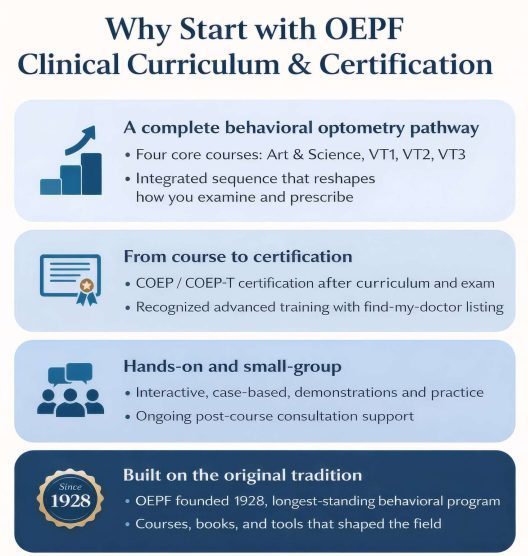
The original postgraduate program in behavioral optometry: a 4-course curriculum and specialty certifications that transform how you practice.
Are you an optometrist, vision therapist, or student searching to unlock a deeper understanding of vision and its profound impact on overall well-being? Are you ready to move beyond conventional approaches and embrace a patient-centered model of care?
Understand both the ‘Why’s” of Vision Therapy as well as the ‘How’s”
At OEPF, our international mission is to provide post-graduate education and increase public access to top-quality vision care. We do this by offering comprehensive, easy-to-understand behavioral optometric education.
What makes these different :
These are not hour-long passive webinars where you click through slides alone. The OEPF Clinical Curriculum Courses are small-group, interactive masterclasses led by world-class faculty in behavioural optometry — where you ask questions, work through real cases live, and leave with a clinical framework you can use the following week.
Every course in the Clinical Curriculum pathway is built around interaction, not passive instruction. You’ll train in small groups alongside Optometrists, Vision Therapists, and Optometry Students — with direct access to expert faculty during and after each masterclass. Case consultations don’t stop when the weekend ends. Post-course support, faculty access, and exclusive graduate rewards are part of every enrolment.
Seeing Beyond Sight
What if vision isn’t just about clarity or acuity, but about how we process, respond to, and interact with the world?
This is the central question posed by behavioral optometry, and it’s where the OEPF Clinical Curriculum begins. Traditional optometry often emphasizes diagnosing and correcting refractive errors—important, but only a fraction of what vision encompasses. Behavioral optometry, by contrast, explores how vision develops, how it influences cognition and movement, and how it reflects a person’s broader physiological and psychological experience.
What is Behavioral Optometry?
Behavioral optometry is a model of vision care that views vision as a dynamic, learned process—one that is intimately connected to posture, movement, attention, emotion, and learning. It recognizes that visual problems can arise not only from the eyes themselves, but from how the brain interprets visual information.
Rather than focusing solely on “seeing clearly,” behavioral optometrists and therapists aim to help patients:
Process information efficiently
Coordinate patient’s visual and motor systems
Integrate vision with learning and development
This holistic approach leads to more personalized, functional, and effective care, especially for patients with visual dysfunctions that affect their academic, occupational, or personal lives.
You’ll learn about:
The Foundational Philosophy and the Key Tenets of Behavioral Optometry: Delve into the core philosophy and intricate structure of the OEPF Clinical Curriculum, understanding the “why” behind its transformative approach.
1. Vision is Learned
From infancy through adulthood, visual abilities are acquired and refined through experience. Challenges such as poor eye tracking, visual processing delays, or spatial confusion are often not just inherited—they are learned and therefore can be retrained.
2. Visual Problems are Often Adaptive
What appears to be dysfunction may, in fact, be the body’s adaptation to stress, trauma, or developmental disruption. Behavioral optometrists look at why a condition exists—not just how to fix it.
3.Treatment Must Be Functional and Individualized
Behavioral optometrists design therapy not just to fix the visual system but to enhance the patient’s quality of life. Vision therapy programs are tailored to each patient’s specific visual habits, goals, and daily needs.
The OEPF Clinical Curriculum is comprised of 4 core courses: each course is designed to deepen your understanding and skills:
The Art & Science of Optometric Care – A Behavioral Perspective
VT1/ Visual Dysfunctions
VT2/ Learning Related Visual Problems
VT3/ Strabismus & Amblyopia
- Additional Course Offerings: Discover other specialized courses based on the teachings and principles of the Core Clinical Courses and OEPF’s model of Behavioral Optometry and Vision Therapy on special topics like Sports Vision, Acquired/Traumatic Brain Injury, and Autism.
 Important Registration Notice
- CE Credits: Our CE courses are automatically approved in several states across the US, including Arizona, California, and Colorado. We also work with you and ARBO to ensure you receive CE credits for all our courses and webinars. We will work with you and your State Boards.
- Certification: Once you complete all core clinical curriculum courses, you qualify for certification: OD or Therapist , becoming an OEPF certified COEP for OD’s or COEP-T as a therapist. We also offer specialty certifications for our Additional Course Offerings.
- Faculty: Our courses are taught by our international faculty of OEPF Instructors, who are all experts in their fields and have completed years of training before being a certified OEPF Faculty instructor.
- A World of Collaboration: Discover the immense value of collaborative learning, mentorship opportunities, and global networking connections that are integral to the OEPF experience.
- Transform Your Practice, Transform Lives: Learn actionable strategies to elevate your practice, enhance patient outcomes, and become a leader in progressive vision care.
If you’re wondering if our courses are right for you, we invite you to browse our website and contact our education office and staff directly for more information. You can also check out our Why take a course? page to learn more about the benefits of our courses.
Get Started Today and find all detailed information in 1 comprehensive eBook!
“Beyond the Eye: A Transformative Journey Through the OEPF Clinical Curriculum,” your comprehensive guide to understanding and applying the powerful principles of behavioral optometry – the very foundation of OEPF’s renowned Clinical Curriculum.
Why a Must-Read?
- Uncover the OEPF Difference: Learn what truly sets the OEPF Clinical Curriculum apart. This program is a four-course sequence meticulously designed to propel you beyond traditional protocols and into a realm of patient-centered vision care that addresses the root causes of visual challenges.
- Embrace Behavioral Optometry: Gain a profound understanding of behavioral optometry and how it empowers you to approach vision as a dynamic, developmental process, not merely a static prescription. Discover how this paradigm shift can revolutionize your diagnostic and treatment strategies.
- Navigate Your Path to OEPF Certification: Get a crystal-clear roadmap to achieving OEPF Certification. The eBook provides detailed insights into the course structure, essential prerequisites, and the tangible, real-world clinical benefits you’ll gain from this esteemed certification.
Who Will Benefit Most?
- Optometrists searching to significantly expand their clinical impact and offer more comprehensive solutions to their patients.
- Vision Therapists seeking deeper, hands-on expertise and advanced techniques to enhance their therapeutic outcomes.
- Students and Professionals exploring the cutting edge of vision care and looking to shape the future of their practice and the profession.
Flexible Learning Options & Important Details
Our clinical curriculum courses fill up quickly, we recommend checking out the OEPF Calendar on our website to stay up to date on our course offerings and registration information. These courses are space-limited to ensure an optimal learning experience for all attendees.
We offer our educational clinical curriculum courses both online and in-person, providing you with the flexibility to engage in an interactive course from the comfort of your own space or in a small group in person. If you’re interested in taking a course in person, please contact Sherice Gainey at sherice.gainey@oepf.org
Our courses are open to licensed optometrists and their therapists, please note that there are special requirements for vision therapists and occupational therapists. To attend a clinical curriculum course, therapists must work under the direct supervision of an Optometrist familiar with behavioral optometry.
As an OEPF Clinical Associate (CA) OD or Therapist (CA-TH) , you’ll receive discounted registration rates on all our Clinical Curriculum Courses, and we offer special scholarship rates for veterans and their families, students, residents, and postgraduates.
Note: All our course materials and contents are copyrighted and owned by the Optometric Extension Program Foundation, Inc.
Recommended Pre-Course Materials:
The Art & Science of Optometric Care – A Behavioral Perspective
Course Readings – VT1/Visual Dysfunctions
VT/Learning Related Visual Problems – (VT-2)
VT3/Strabismus and Amblyopia

Recommended Podcasts:
Listen to our Clinical Curriculum Presentation